Frequently asked questions
How do I check today's train schedule?
Pick your country and station below. Each station page lists the next departures with the scheduled time, the train, its destination and — in countries where the operator publishes it — the live delay. The page refreshes itself, so what you see is today's timetable as it stands, not a printed plan.
Which countries does Trainradar24 cover?
Departure boards run for over 490 stations in 14 countries: Poland (129 stations), the Netherlands (46), Italy (36), Switzerland (36), Norway (36), Great Britain (33), Austria (32), Canada (22), the United States (36), France (20), Finland (18), Spain (16), Belgium (16) and Germany (14). Poland is the largest market and the only one where the station pages are in Polish.
Does the timetable show live delays?
It depends on what each operator publishes. Poland, the Netherlands, Switzerland, Norway, France, Finland and Belgium carry live delays. Great Britain, Germany, Spain, Italy, Austria, Canada and the United States show planned times for now — the status column is left out rather than filled with a guess.
Where does the departure data come from?
From each country's official open data: PKP PLK in Poland, National Rail Enquiries in Great Britain, OVapi in the Netherlands, SNCF in France, Fintraffic in Finland, Renfe in Spain, NMBS/SNCB in Belgium, gtfs.de / DELFI in Germany, opentransportdata.swiss in Switzerland, Entur in Norway, ÖBB in Austria, Trenitalia in Italy, VIA Rail in Canada and Amtrak in the United States. The full list with licences is further down this page.
How do I check train times in Poland?
Pick a Polish station from the list on this page. For each station we show the next departures: scheduled time, operator and train number, direction, platform number and the real status — on time, a delay in minutes, or cancelled. The board refreshes on its own.
What does Główny mean in a Polish station name?
Główny (or Główna) means main, so Kraków Główny is Kraków main station. Other common suffixes are Centralna (central, as in Warszawa Centralna), Wschodnia (east), Zachodnia (west) and Miasto (city). Large cities have several stations, so the suffix matters: a ticket to Warszawa Centralna is not the same station as Warszawa Wschodnia.
Who runs trains in Poland?
PKP Intercity operates most long-distance services between major cities. POLREGIO and a set of regional operators owned by the provinces run local and regional trains. Suburban networks such as SKM in Warsaw and the Tricity area serve city areas. Our boards show the operator next to every departure.
Are Polish trains punctual?
In the second quarter of 2026 the national regulator recorded 89.3% punctuality for passenger trains, down from 93.3% a year earlier, with June the weakest month at 86%. A train counts as punctual if it arrives no more than 5 minutes 59 seconds late, so the share of journeys where something actually went wrong is higher than the headline figure suggests.
Can I check the timetable in the Trainradar24 app?
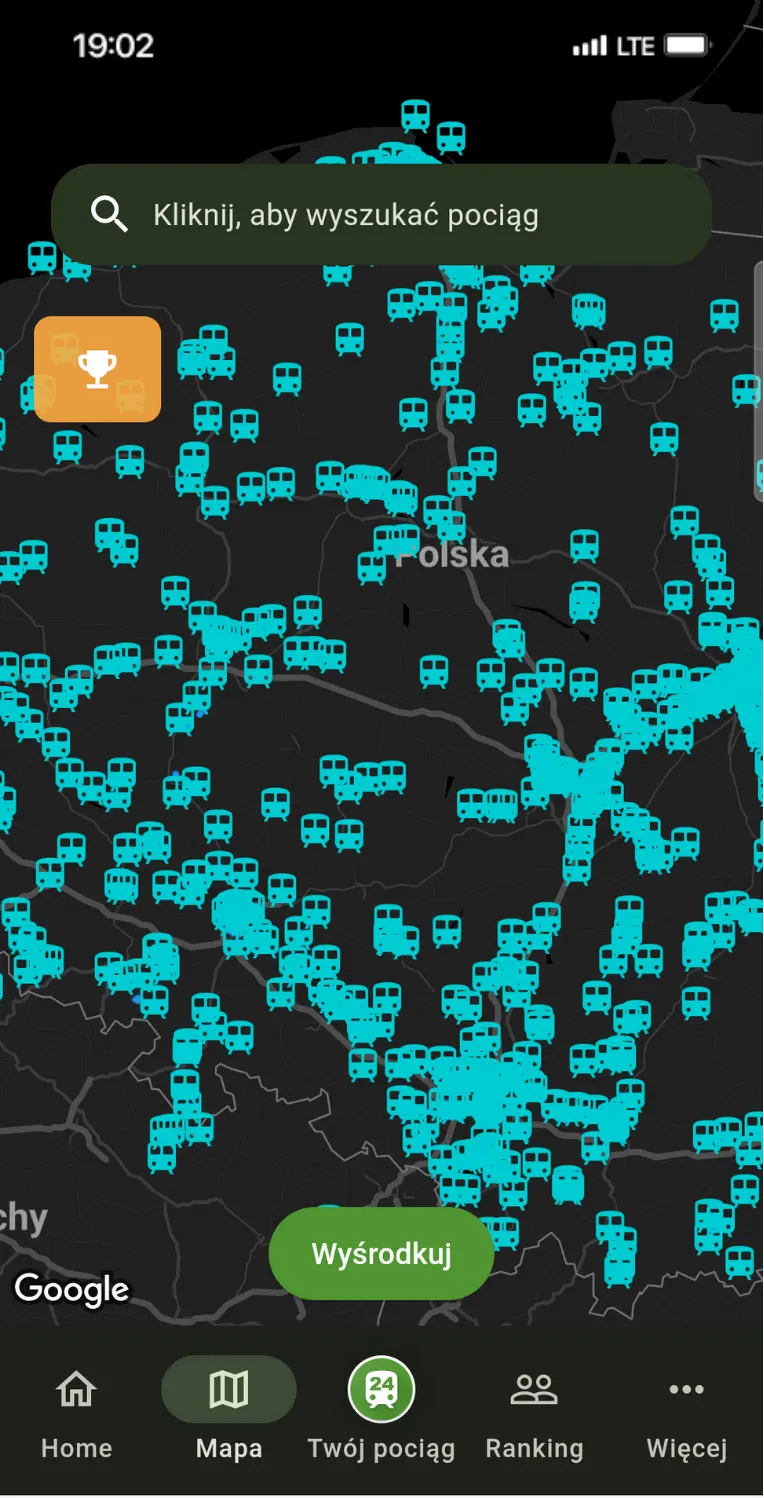
Yes. The app has departure and arrival boards, the timetable of an individual train with every stop on its route, a live train map and push notifications for delays and cancellations. It is free, on Android and iOS, and needs no account.