ETCS explained: how the system that stops trains on its own works
30 October 2026 | Natalia, Trainradar24 editorial team
At 300 km/h a high-speed train covers more than 80 metres every second and needs several kilometres to stop. At that speed it is not enough for the driver to see signals well: the railway needs a system that reliably brings information into the cab and supervises the run. In Europe, that is increasingly ETCS — a computer in the cab knows how far and how fast the train may go, and applies the brakes if the driver does not react. Here is how it works, where it is already in use and why the EU wants it on every main line.
- ETCS (European Train Control System) is the common European train protection system. Together with the railway radio GSM-R it makes up ERTMS.
- It supervises speed and the point where the train must stop. If the train goes too fast, the system warns the driver and then brakes automatically.
- In Britain, ETCS runs on the Cambrian Line in Wales and through the Thameslink core in London, where it works together with automatic train operation.
- Under EU law, ETCS must cover the TEN-T core network by the end of 2030 and the whole TEN-T network by 2050.
Why are signals not enough?
A train needs far more distance to stop than a car: from 160 km/h (100 mph) the braking distance is about a kilometre, and much more at higher speeds. Classic signalling works because the driver sees each signal early and knows the route. The faster the train, the smaller the margin for error — fog, a moment of inattention or a misread signal can be enough to pass a signal at danger.
Railways have long used systems that step in: AWS and TPWS in Britain, PZB and LZB in Germany, KVB in France, ASFA in Spain. But every country built its own, so a locomotive crossing a border had to carry several sets of equipment. ETCS replaces them with one shared standard.
How does ETCS work?
The key idea is the movement authority: a message telling the train “you may go as far as this point, at this speed”. The on-board computer knows the train’s weight and brakes, so it calculates a braking curve — the moment the train must start slowing down to stop before the end of its authority or to meet a speed restriction.
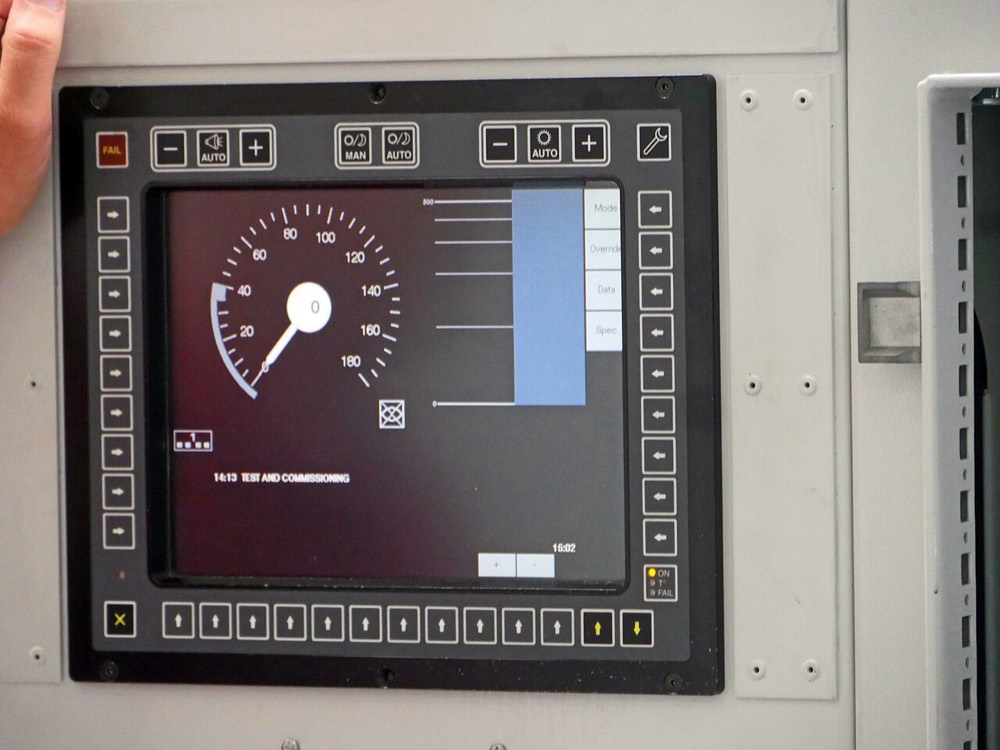
The driver still drives the train, but the cab display (DMI) shows the permitted speed, the target speed and the distance to the target. As the train approaches the limit, ETCS first warns. If nobody reacts, it applies the brakes itself.
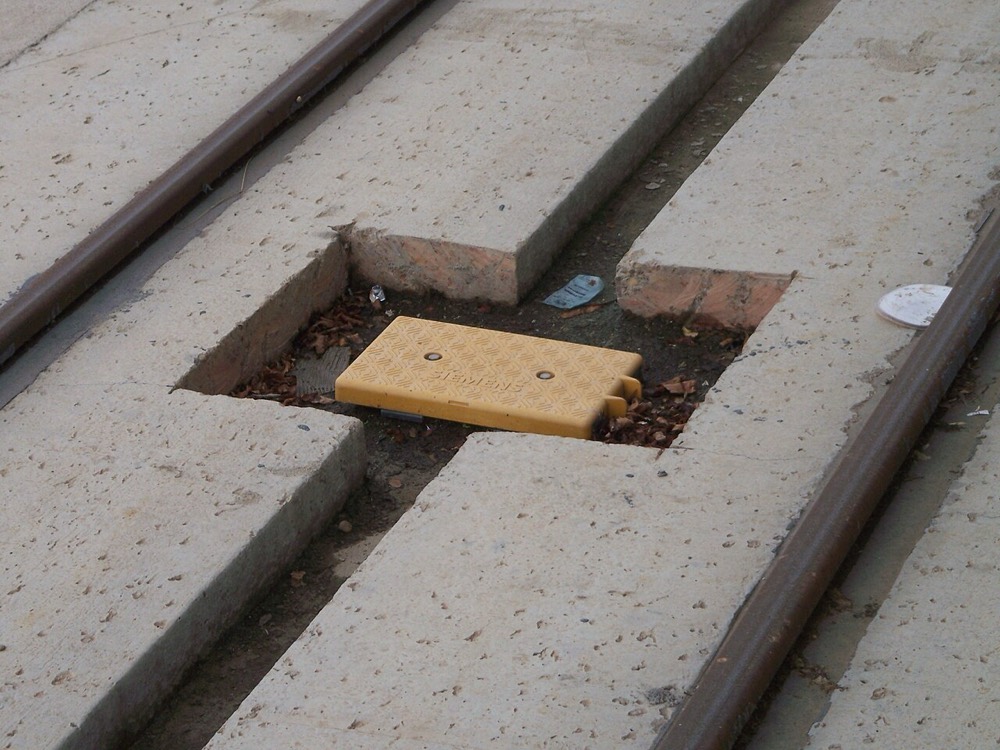
The yellow boxes between the rails: Eurobalises
How does the train know where it is? From Eurobalises — flat, usually yellow devices fixed in the middle of the track. They need no power supply: when the train’s antenna passes over, its energy wakes the balise up and it sends back a short message called a telegram. It contains the exact position and, on some lines, the movement authority and speed limits too. Between balises the train measures the distance travelled itself (wheel sensors, radar), and each balise corrects that reading.
Fixed balises always send the same message, such as “you are at kilometre 152.4”. Switchable balises are linked to the signalling and change their message depending on what the signal shows. They are usually laid in groups of two or more, so the train can also tell its direction.
Level 1 and Level 2 — what is the difference?
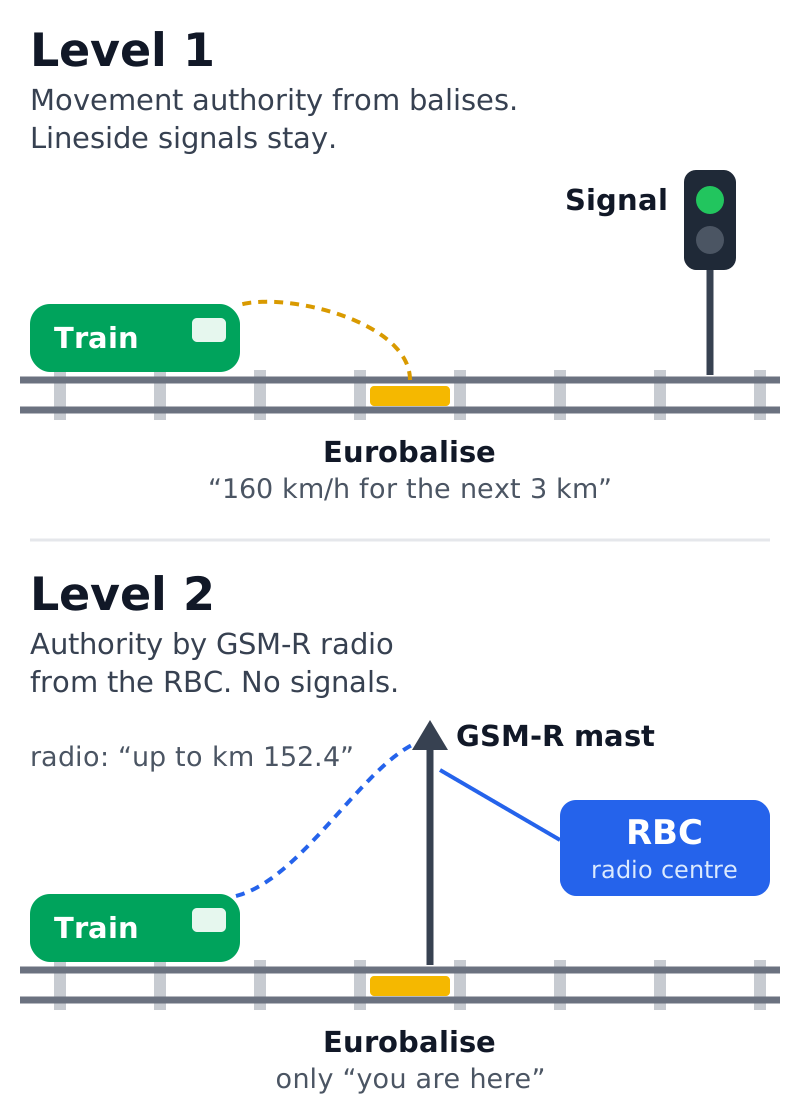
ETCS comes in several variants, called levels. They differ in where the train gets its movement authority from.
- Level 1. The authority comes from balises in the track and lineside signals stay in place. The drawback: in the basic form the train only learns about a change at the next balise; Euroloop cables or radio infill can add updates in between.
- Level 2. The authority comes by radio from a Radio Block Centre (RBC) over GSM-R. It is updated continuously, so the system can work without lineside signals — although many lines keep them. Balises remain, mainly as location markers.
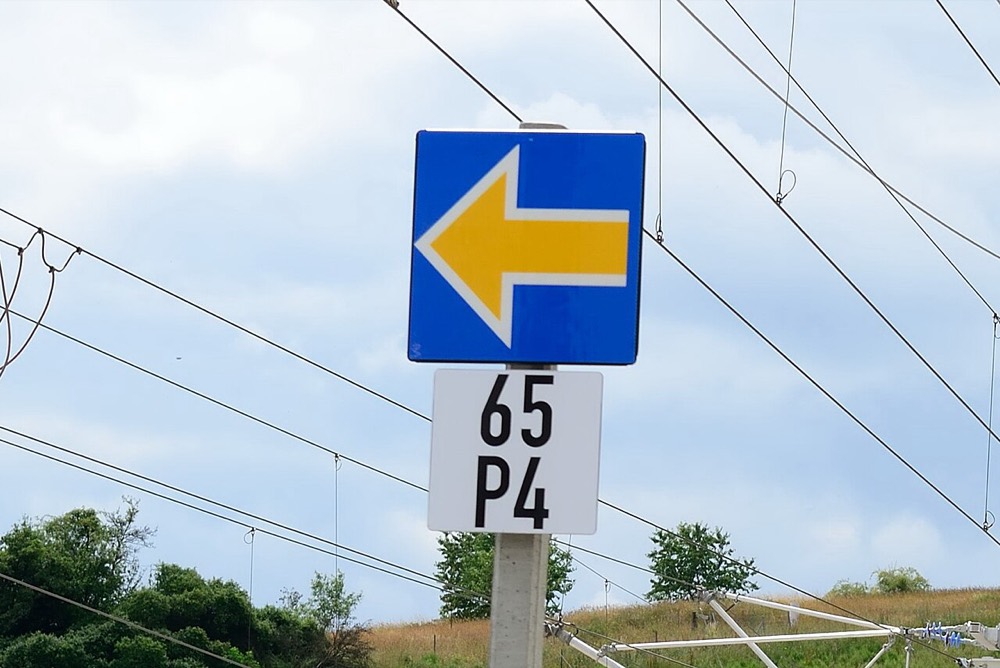
On Level 2 lines without signals, blue boards with a yellow arrow (ETCS stop markers) show where a movement authority can end. The train stops there when the cab display tells it to.
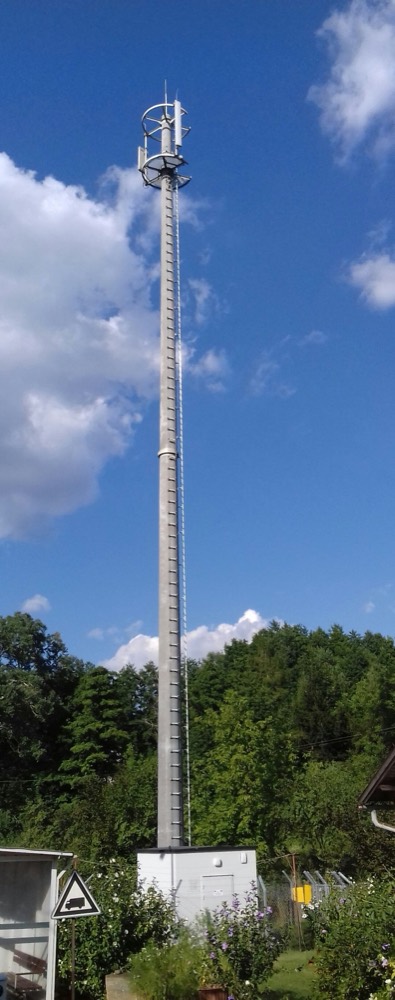
A Level 2 train is in constant contact with the RBC over GSM-R, the railway’s own mobile network with masts along the line. It reports its position and gets new authorities in return.
What happened to Level 3?
For years ETCS also described a Level 3, in which the train itself confirms it is complete, so track-based train detection is no longer needed. That allows a “moving block”: the gap between trains is worked out continuously from braking distance and safety margins rather than from fixed track sections. In the current rules (the 2023 TSI CCS) it is no longer a separate level; its functions became options within Level 2. In practice it is still mostly at the pilot stage.
ETCS in Britain and Europe
Britain’s first ETCS Level 2 line was the Cambrian Line in mid-Wales, in service since the early 2010s. In London, the Thameslink core through Blackfriars has run ETCS with automatic train operation since 2018, which lets more trains squeeze through central London than conventional signals would. In 2025 the Northern City Line into Moorgate became the first part of the East Coast Digital Programme to run without lineside signals, ahead of ETCS on the East Coast Main Line itself.
On the continent, Germany’s Ebensfeld – Erfurt high-speed line has run on ETCS Level 2 without main signals since December 2017. Switzerland has fitted most of its network with a simplified Level 1, and only trains with Level 2 may use the Gotthard Base Tunnel. Spain has one of the largest ETCS networks in Europe — about 2,700–3,000 km of track. Poland’s Pendolino reaches 200 km/h only on the ETCS-equipped Central Rail Line.
The US uses a different system with the same goal: Positive Train Control (PTC), required by a 2008 law after the Chatsworth crash and in place on all mandated routes since the end of 2020.
Why it matters for safety
ETCS reduces the risk of accidents caused by overspeeding or by running past the end of a movement authority, using warning and intervention thresholds — most effectively in full supervision. It is not infallible: when equipment fails, the system drops into degraded modes in which the train runs slower and safety depends largely on people again — the signaller and the driver.
When will ETCS cover the whole EU?
The deadlines are set by Regulation (EU) 2024/1679 on the TEN-T network. ERTMS must cover:
- the core network — by the end of 2030,
- the extended core network — by 2040,
- the comprehensive network — by 2050.
National legacy systems are to be switched off step by step on the relevant parts of the TEN-T network, by 2050 at the latest, with conditions and exemptions. Progress is slow: according to the third ERTMS Work Plan (February 2026), at the end of 2024 about 12,400 km — some 10% of the TEN-T network — was equipped, and 17% of the core network (10,600 km). The European Commission expects that, on current plans, only about half of the 2030 core-network target will be met.
Frequently asked questions
What does ETCS stand for?
European Train Control System. Together with the GSM-R radio it forms ERTMS, the European
Rail Traffic Management System.
Does a train with ETCS drive itself?
No. A driver is in charge; ETCS supervises and brakes if nobody reacts. Automatic train
operation (ATO) is a separate system that can be built on top of ETCS, as on Thameslink.
What is the difference between ETCS Level 1 and Level 2?
In Level 1 the information comes from balises and signals stay by the track. In Level 2 it
comes continuously by GSM-R radio and the system can work without lineside signals.
Is ETCS the same as PTC?
No. Both stop trains from passing a stop point or exceeding speed limits, but ETCS is the
European standard and PTC covers the systems used in the United States.
Sources: Regulation (EU) 2024/1679 (TEN-T), Implementing Regulation (EU) 2023/1695 (TSI CCS), European Union Agency for Railways (ERA), European Commission — ERTMS, Swiss Federal Office of Transport, Network Rail and Govia Thameslink Railway announcements. Photos: Wikimedia Commons, author and licence under each image.

