Overhead line explained: how the catenary and pantograph power a train
30 October 2026 | Natalia, Trainradar24 editorial team

Most fast and busy trains in Europe draw their power from wires above the track. In Britain this is called overhead line equipment (OLE), elsewhere the catenary. It is more than one wire: a messenger wire, a contact wire, droppers, masts and substations that turn grid power into train power. Here is how it is built, how the current reaches the train, why Britain uses 25,000 volts overhead and 750 volts on a third rail, and why a damaged wire can stop trains for hours.
- The overhead contact line (catenary) is the set of wires above the track that an electric train collects power from with its pantograph. It is the visible part of the traction power system, which also includes the return circuit and the substations that feed it.
- Current flows from a substation along the contact wire into the train and back through the return circuit, mainly the rails.
- Britain's main lines use 25 kV AC at 50 Hz; much of southern England uses 750 V DC from a third rail instead.
- The wires are always live. Getting close is enough to be killed – you do not need to touch them.
What is an overhead line made of?
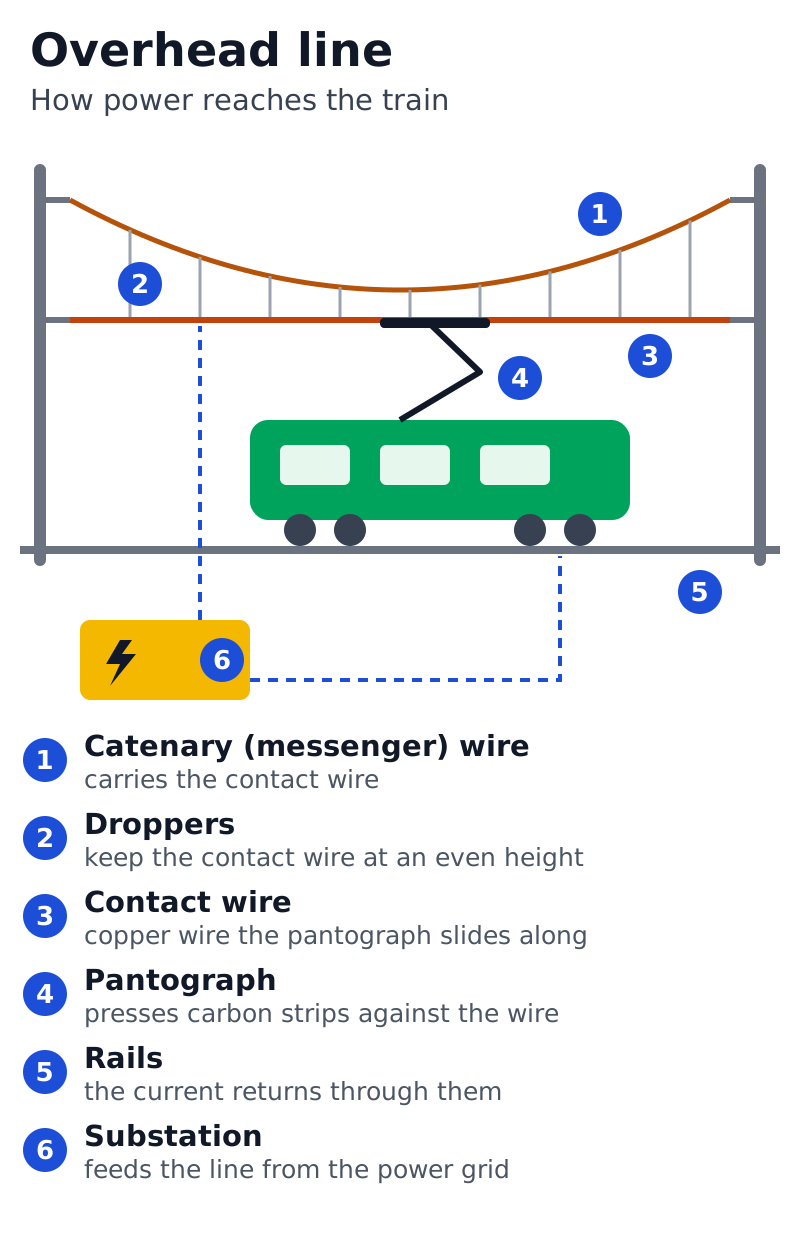
On main lines the power does not come from a single wire. At the top runs the catenary or messenger wire, which sags between the masts. Hanging from it on droppers is the contact wire, a copper wire that the pantograph slides along. The messenger sags most in the middle of each span, so the droppers are shortest there and longest at the masts. That keeps the contact wire almost level.
The contact wire is not hung exactly above the centre of the track. It runs in a zigzag (stagger), left and right, so that the pantograph's carbon strips wear evenly instead of in one groove.
Copper expands in heat and contracts in cold. To stop the wire sagging in summer or snapping in winter, the line is split into sections, usually up to about a mile and a half long, with balance weights at the ends. These stacks of weights on some masts rise and fall with the temperature and keep the tension constant. Even so, very hot days can make older wiring sag, which is one reason for heat-related speed restrictions.
How does the power reach the train?
Power comes from the national grid. Feeder stations and substations along the line reduce the voltage and feed it into the overhead wires. With 25 kV AC they can be far apart, because high voltage means a lower current for the same power.
On the roof sits the pantograph, a folding current collector. Springs or an air bag press it up against the contact wire. Contact is made through carbon strips: carbon conducts well and wears away instead of damaging the copper. The current feeds the train's electrical equipment – transformer, converters and traction motors – and the circuit is closed through the return path, mainly the rails, back to the substation.
Why 25 kV overhead and 750 V on a third rail?
The south of England electrified early, mostly in the 1920s and 1930s, using a third rail beside the track with 600–750 V DC. It is cheap to build and fits under low bridges and tunnels, but its low voltage – rather than the use of DC as such – means very high currents, so substations must be close together and speeds are limited. When British Railways electrified the West Coast Main Line from the 1950s onwards, it chose 25 kV AC at 50 Hz overhead, taken straight from the public grid. The same system is used on the East Coast and Great Western main lines and on HS1.
Across Europe there is no single standard. Older networks run on DC, Germany and its neighbours on their own 16.7 Hz system:
| Country | Voltage |
|---|---|
| United Kingdom, Ireland (DART) | 25 kV 50 Hz AC overhead; 750 V DC third rail in southern England; DART 1.5 kV DC |
| Germany, Austria, Switzerland, Sweden, Norway | 15 kV 16.7 Hz AC |
| France | 1.5 kV DC and 25 kV 50 Hz (high-speed lines, north and east) |
| Netherlands | 1.5 kV DC; 25 kV 50 Hz on HSL-Zuid and the Betuweroute |
| Poland, Belgium, Italy, Spain | 3 kV DC (25 kV 50 Hz on Belgian, Italian and Spanish high-speed lines, and on some other Belgian sections) |
That is why Eurostar trains are multi-system: they run on 25 kV on high-speed lines and can also work on 3 kV DC in Belgium and 1.5 kV DC in the Netherlands once they leave them. Where two systems meet there is a short neutral section that the train coasts through with its power switched off.
Why do the wires come down, and why does everything stop?
“Overhead line problems” are among the most common causes of long delays. Typical causes are:
- storms – trees, branches and debris such as trampolines blown onto the wires;
- ice on the contact wire, which breaks the contact, causes arcing and can damage the wire or pantograph;
- a damaged pantograph that snags the wire and pulls it down over a long stretch (a “dewirement”);
- cable theft, fires and lightning.
Before repairs can start, the section has to be switched off and earthed. Electric trains cannot pass, and stranded trains may have to be rescued by a diesel locomotive. You can watch the knock-on delays live on Trainradar24, for example at London Euston or London King's Cross.
Why are overhead lines so dangerous?
25,000 volts is about a hundred times the voltage of a UK plug socket. At that voltage electricity can jump through the air, so you can be killed simply by getting too close. Network Rail and the British Transport Police warn every year about people, often teenagers, climbing onto trains or structures near the wires.
- Treat the wires as live at all times – also at night and when no trains are running.
- Never climb on trains, masts or bridges over the line, and keep kites and fishing rods well away.
- If a wire is down, stay well back, warn others and call 999 (or 112).
Frequently asked questions
What voltage are UK overhead lines?
25,000 volts AC at 50 Hz. Third-rail lines in southern England and on Merseyrail use
750 volts DC.
What is a pantograph on a train?
The folding arm on the roof of an electric train. It presses a head with carbon strips
up against the contact wire.
What are the weights hanging from some masts?
Balance weights. They keep the wires taut as the copper expands in the heat and
contracts in the cold.
Why don't birds on the wires get electrocuted?
A bird sitting on one wire has both feet at almost the same potential. The voltage
between them is tiny, so only a negligible current flows through it. The danger comes from touching
a wire and an earthed mast at the same time, which is how large birds are sometimes
killed.
Sources: Network Rail, British Transport Police, ProRail, Infrabel, Regulation (EU) No 1301/2014 (Energy TSI), Fraunhofer ISE (German traction power), RFI (Italy).

